Where It Comes From
When Erindor was in it’s youngest age, magic was fickle and chaotic. The old chronicles called it the Untamed Weave, a storm of raw power that swept the land unbidden, twisting those unlucky enough to wield it. Few who touched it lived to grow old.
From a solitary island came Elué, the first true Magus, whose calm mastery bent even the wildest currents to order. Where she walked, the winds grew still. At the heart of the continent she raised the first runic stone and around it, in time, rose the Schola Arcanis, keeper of magic’s laws ever since.
It is fitting, then, that the same hand which tamed the Weave also tamed the year. The calendar used today carries her name and her discipline: Order and Clarity.
— attributed to Alexander Darkcloak, first Disciple of Elué
How It Works
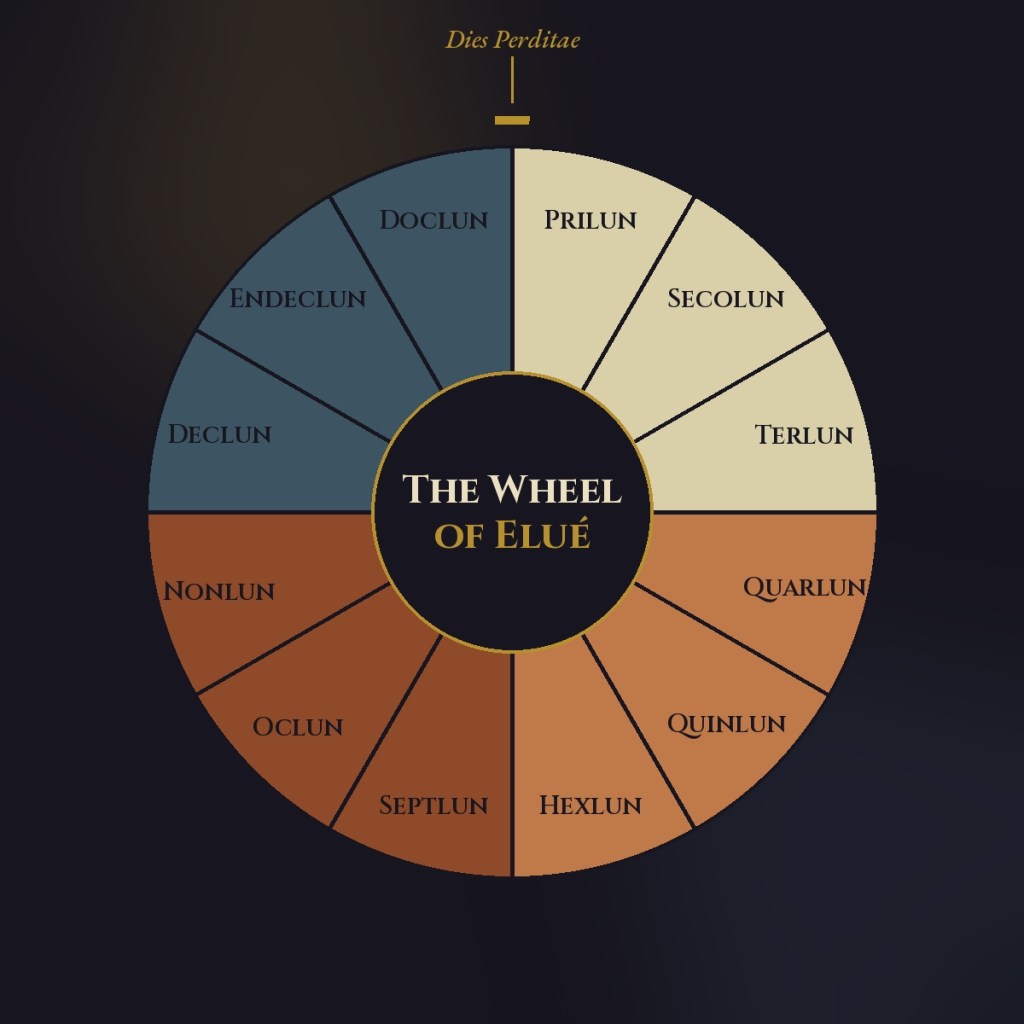
The Calendar divides the year into twelve months, each exactly thirty days long. No exceptions, no leap years, no ragged edges, every month is identical in length to every other.
Each month takes its name from its place in the year: an old numeral root joined to the suffix -lun, echoing luna. (the Moon) Prilun is simply “the first moon-cycle.” Doclun, the twelfth and last.
The year opens with Prilun in early spring and closes with Doclun in late winter. Between Prilun and Doclun there are five days that herald the ending of the year and the new beginning.
The Kingdom of Erindor is the oldest Kingdom of the land, therefore the Calander has found it ways and uses in the neighboring kingdoms as wel, out of trade convience.
Only the savage Wildlanders refuse to use it, they prefer their own simplistic and crude ways…
The Twelve Months
| Month | Season | Roughly corresponds to |
|---|---|---|
| Prilun | Spring | March |
| Secolun | Spring | April |
| Terlun | Spring | May |
| Quarlun | Summer | June |
| Quinlun | Summer | July |
| Hexlun | Summer | August |
| Septlun | Fall | September |
| Oclun | Fall | October |
| Nonlun | Fall | November |
| Declun | Winter | December |
| Endeclun | Winter | January |
| Doclun | Winter | February |
The Five “lost” Days, “The Dies Perditae” period.
Twelve months of thirty days account for three hundred and sixty. Five days remain and they are rather special.
“The Dies Perditae period” fall at the very end of the year, in the narrow gap between the last day of Doclun and the first day of the next Prilun.
During these five days Magic becomes rather fickle, unstable even, chaotic at worst. Some claim that the veil between our world and the world of the living becomes freigthening thin. Doomsayers herald the endtimes and blame those five days of the birthperiod of the monsters that plague the world…
In Erindor (and beyond) these five days are celebrated, but Mages withdraw themselves from public almost completely.
The Six Days of an “Erindorian” week.
Just as the months carry the discipline of Elué, the days of the week carry the memory of Erindor’s first kings and those who made an impact on Erindor’s history.
The first day, “Erinsday”
Named for Erin “the Great” Highmoor, who slew the darkness that once plagued these lands and founded the Kingdom of Erindor itself. Some names are too solemn to shorten, and so this one is spoken today exactly as it was first carved into stone.
The 2nd day, Evertonsday, commonly “Tonsday“
Named for King Everton, who ended the Brother’s War against Breamor through his marriage to Princess Sophie, securing the borders that still stand today. Worn down by generations of hurried speech, only the last syllable survived.
The 3th day, Aureliusday, commonly “Arsday“
Named for King Aurelius, who took Magus Elué’s hand in marriage and, with it, ended a war against magic itself. His name, the most foreign-sounding to common ears, was also the quickest to be worn smooth.
It even became a common saying: “This is Arsday, I’m not giving an arse today ’bout work!” It’s become the unofficial rest day in the middle of the week, most widely practiced by commoners. Nobility and those of the Schola still refer to it properly as Aureliusday, they don’t have the luxury of publicly not giving an arse.
The 4th day, Marcusday, commonly “Marksday“
Named for King Marcus of Highmoor, whose death without an heir plunged the realm into the War of the Houses. Fittingly or not, “Marksday” remains the designated market day in many Erindor towns to this day.
The 5th day, Harrigansday, commonly “Harrowsday“
Named for King Harrigan, who ended that same war and brought every noble house to kneel and swear fealty, right before his death. A harrowed name, for a king forged by a harrowed land.
The 6th day, Cedricsday, commonly “Cedsday“
Named for King Cedric, crowned at only fourteen, inheriting a kingdom still reeling from broken noble houses and civil war, only to be thrown immediately into war against the Triumvirate of Evil. He met it with a tactical mind and diplomatic hand far beyond his years, and by the time the Triumvirate fell during the March of Darkness, he’d proven himself one of the most capable rulers Erindor has ever known, arguably the greatest king the realm has seen. It was Cedric who founded the Order of the Chimerae, and decades later, who stood behind the founding of the Venator Program as well.
But conviction, carried far enough, curdles. His own words survive in the chronicles: “If the price of peace is blood and flame, then let our mages burn brighter than the darkest night.” Under his rule, mages were pushed, at times against their will, into dangerous self-experimentation the Schola Arcanis had explicitly forbidden. A shadow on an otherwise shining legacy, and one historians still argue over today.
“Cedsday“, is the official resting day for the Kingdom (and beyond). No hard labour or loud noices should be made that day, it is for remembering the Kingdom and their rulers and cherish the good times Erindor now has.
Scribes, scholars, and the Schola Arcanis still use the full, formal names in writing. On the street, in the market, and around the hearth, it’s the short forms everyone actually uses, a small, everyday reminder of how differently the learned and the common remember the same six kings.
To the timeline of Erindor!
 Erindor