A harsh kingdom of mountain gold, broken loyalties, unsafe roads, old powers, and survival before ideals...
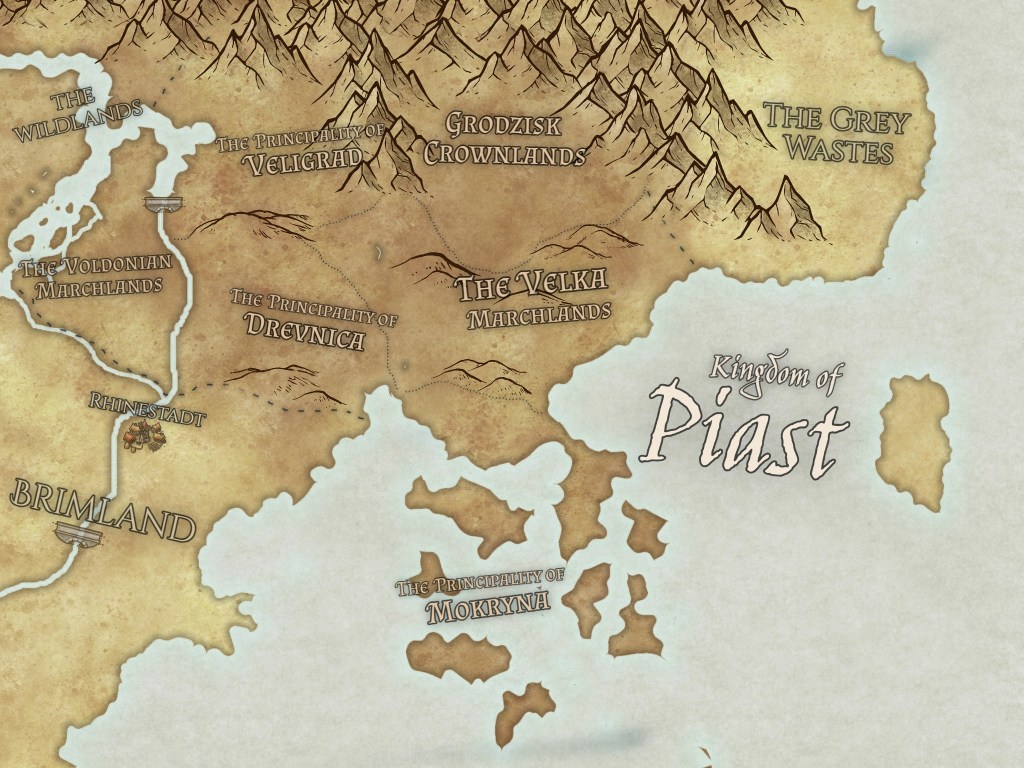
Piast is an old and rugged kingdom of mountains, forests, rivers, poor villages, fortified roads and dangerous borders. On a map, it may look like one kingdom. In reality, Piast is fractured by royal feuds, local power, old grudges and lands that have learned to survive without waiting for permission.
To outsiders, Piast often seems cruel, stubborn, poor, suspicious, and deeply superstitious. To those born there, it is simply home.
A hard home, perhaps. An unforgiving one. But also a land of family, endurance, old customs, quiet kindness and stories that are never fully forgotten.
In one glance
Known for: harsh landscapes, fractured authority, old powers, unsafe roads, family loyalty, superstition and dark spirituality, warlords and survival.
Common values: endurance, caution, tradition, blood ties, practicality and keeping your word carefully.
Outsiders may see Piastans as: rude, dangerous, superstitious, poor, cold, cruel, or untrustworthy.
Piastans may see outsiders as: soft, arrogant, naïve, loud, careless, and far too trusting.
Best for characters who are: survivors, deserters, hunters, folk healers, shrine keepers, mercenaries, suspicious villagers, local guides, miners, caravan guards, minor nobles, oathbound warriors, or people shaped by hard choices.
A kingdom in name
Piast is ruled from the capital of Grodzisk, where the King still holds the Crownlands. Officially, his word is law.
But Piast is no longer a united kingdom in any meaningful sense. The royal family itself is divided. Several great regions are ruled by princes and princesses of the blood, many of whom have risen in open rebellion against the King and against each other. A short but brutally bloody civil war left the kingdom exhausted. Armies marched, villages burned, loyalties broke, and noble houses spent more lives than they could afford.
Now, Piast lives under an uneasy truce.
The great battles have stopped, but the war has not truly ended. Assassinations, sabotage, blackmail, quiet alliances, and noble conspiracies continue behind closed doors. Among the common people, life has begun to move again. Trade has resumed, often without anyone officially allowing it. Farmers return to fields. Merchants take risks and villages repair what they can.
Most people no longer care which royal cousin insulted which prince ten years ago. They care whether the roads are safe, whether the harvest survives, whether taxes are collected twice, and whether armed men come knocking before winter.
None of the nobles, not even the King, currently has enough support to raise a proper army again. This weakness is one reason why the Warlords of the Voldonian Marchlands, officially claimed by Piast, continue to act almost freely.
The Crownlands
The Grodzisk Crownlands are the official heart of Piast and remain under the direct authority of the King. They are extremely well protected. Harsh mountain ranges guard the region by nature, and the King’s own military strength makes Grodzisk one of the hardest places in Piast to attack directly. The mountains are rich in gold and silver, giving the crown access to great wealth.
But wealth alone does not feed a kingdom. The Crownlands’ greatest challenge is not finding coin, but turning that coin into goods. Gold and silver cannot repair roads by themselves, fill granaries, raise horses, harvest timber, move medicine, or keep soldiers supplied.
Trade routes are unreliable. The Principalities are rebellious. The Marchlands are unstable. The roads are dangerous. The King may have treasure in his vaults, but getting food, cloth, timber, iron, animals, tools, and skilled hands into Grodzisk has become increasingly difficult.
Because of this, merchants, smugglers, caravan guards, diplomats, and loyal messengers have become more important than many nobles would like to admit.
A character from the Crownlands may come from the most protected and officially loyal part of Piast. They may be shaped by royal law, mountain roads, mining towns, military discipline, court politics, or the strange reality of a rich king who is still surrounded by enemies.
The Principalities
The Principalities are regions ruled by members of the royal family. In theory, they are still part of Piast. In practice, many of them answer only to themselves.
Some princes claim they are protecting the kingdom from a weak king. Others claim the throne should have been theirs. Some speak of tradition, law, blood, or duty. Some are simply ambitious and most are dangerous.
The Principalities are not all the same. Some are militarized and proud. Some are old, wooded, and deeply traditional. Some, like the island Principality of Mokryna, are shaped more by tide, clan, ferry routes, salt, and smuggling than by courtly politics.
People from the Principalities may be loyal to their local ruler, resent the King, hate the other royal branches, or quietly wish all nobles would finally choke on their own bloodlines and leave the villages alone.
A character from a Principality may carry divided loyalties. They might serve a rebel prince, flee from one, spy for another, or simply come from a village that has learned to survive beneath banners that keep changing.
The Marchlands
The Marchlands are the unstable border regions and neglected territories where Piast’s control is weakest.
These are lands of broken roads, old forts, ruined patrol routes, local strongmen, desperate villages, warlords, raiders, and communities that survive because no one else will protect them. In the Marchlands, a royal decree means very little if there is no one strong enough to enforce it.
The Voldonian Marchlands are one such region. Official Piastan maps may mark them as part of the kingdom, but the old name Voldonia still carries weight. The clans remember. The old powers linger. Brimland contests the region. Erindor has long abandoned it. Piast claims it, but does not truly control it.
To Piast, Voldonia is a border problem, to its old clans, it may be a homeland waiting to rise again.
The Grey Wastes
To the east lie the Grey Wastes, a barren and desolate land of cold wind, stone, dust, and hard survival. Few people from the settled parts of Piast speak of the Grey Wastes with affection. It is a place of raiders, orcish tribes, exiles, desperate caravans, and old roads that vanish into rock and weather. The land is not empty, but it is unforgiving.
Piastans often treat the Grey Wastes as a warning more than a destination. People who come from there are usually assumed to be dangerous, half-wild, or impossible to frighten.
Life in Piast
Most people in Piast do not live in grand cities or beautiful courts. They live in villages, mining towns, border settlements, roadside inns, fishing communities, forests, and mountain passes. Life is practical before it is pretty.
Clothing is often simple, worn, repaired, and chosen for survival rather than elegance. Tools matter. Food matters. Firewood matters. A good pair of boots may be worth more than a noble promise.
Authority is usually local. People rely on family, clan, neighbours, patrons, village elders, shrine keepers, armed relatives, or whoever can actually help when trouble comes. The law may exist somewhere far away, but the road between here and there is long.
A Piastan may respect strength, but not necessarily cruelty. They may value kindness, but distrust kindness that comes too easily. They may be generous to a guest, but only after deciding the guest is not a threat.
In Piast, survival comes before ideals.
That does not mean Piastans have no honour. It means honour is often smaller, older, and more personal. A promise to a dying mother may matter more than the command of a prince. A debt to a village may matter more than the law. Blood spilled on family land may be remembered longer than any written contract.
Old powers and superstition
In Piast, people rarely speak of gods in the way other lands might.
The old powers are not distant creators or moral judges. They are forces to be acknowledged, feared, thanked, avoided, or endured. Some may once have been human. Some may be older than memory. Some may be stories that became too heavy to die. People do not always pray loudly in Piast. More often, they follow small habits.
A piece of bread before a journey.
A sip of drink at the threshold.
Clean water before tending a wound.
A quiet fire through the night.
A name spoken once in winter and not repeated.
A little blood in the soil before planting.
A full cup offered before the last song is sung.
To an outsider, these things may look like superstition.
To a Piastan, they are common sense.
The supernatural is rarely obvious in Piast, but it is always close. It lives in warnings, charms, stories, taboos, strange silences, and places people avoid after dark.
A Piastan character does not need to be religious. They may laugh at half the old customs. But they probably still know which ones not to ignore.
Magic in Piast
Magic in Piast is both respected and feared.
Among the nobility, magic is treated as a dangerous but valuable tool. Many noble houses try to keep at least one sorcerer, sage, or learned advisor close at hand, both for protection and for guidance. A skilled magic user can be a weapon, a warning, a counsellor, or a symbol of status.
But outside courts, castles, and powerful households, magic is far less safe to display.
In farming villages and poorer regions, magic users are often met with suspicion or fear. A healer who knows too much, a child who dreams too vividly, a stranger who speaks strange words, or someone whose presence seems to bring misfortune may quickly become a target. Some are shunned. Some are bullied. Some are driven away. Some are hunted down and killed by people terrified of what they do not understand.
On the isles of Mokryna, there are rumours of an academy where sorcerers are trained. It is said to be as hard to find as it is to enter. Those who seek it must first prove they are worthy, and its tests are known to be brutal. Some say they are not merely trials, but a deliberate culling of the weak.
For a Piastan magic user, power can open doors that would otherwise remain closed. It can also make every neighbour, noble, priest, or frightened mob wonder whether you are a blessing, a weapon, or a threat.
If your character is from Piast
A character from Piast is likely shaped by caution, hardship, and local loyalty.
They may trust family before law, village before kingdom, and experience before noble ideals. They may be careful with promises, slow to trust outsiders, respectful of old customs, and uncomfortable when others mock things they do not understand.
Coming from Piast can mean you grew up around unsafe roads, old family feuds, harsh winters, local tyrants, strange rituals, dangerous forests, mining towns, border raids, or villages where everyone knows more than they say.
A Piastan character does not need to be grim, cruel, or hostile. They can be warm, funny, generous, protective, faithful, romantic, curious, or deeply kind.
But their kindness probably has roots.
They know what it costs, and what it can be worth.
Character ideas from Piast
A Piastan character could be:
A folk healer who mixes herbs, charms, and practical medicine.
This could become a Ritualist, an Arcanist, or simply someone with deep local knowledge and old village customs.
A caravan guard trying to keep trade alive between fractured regions.
This could become a Paladin, an Enhanced, or a hardened Adventurer who knows that coin, roads, and trust are all dangerous things.
A spy, messenger, or minor noble caught in the cold war between the royal families.
This could become an Arcanist, a Paladin sworn to a cause, or someone whose true loyalty is far more complicated than their name suggests.
A deserter, exile, or survivor shaped by warlords, old feuds, or unsafe borders.
This could become an Enhanced, a Paladin, or a broken wanderer trying to decide what they still believe in.
A smuggler from Mokryna.
This could become a clever Arcanist, a practical survivor, or someone who knows that tide, fog, and silence are better allies than banners.
A raider-born wanderer from the Grey Wastes.
This could become an Enhanced, a brutal fighter, a strange mystic, or someone trying to escape the life others expect from them.
Your homeland can inspire your archetype, but it does not decide it for you. A Piastan healer does not have to be a Ritualist. A warrior does not have to be a Paladin. A mystic does not have to be an Arcanist. Start with the character first, then choose the archetype that best supports the story you want to play.
How others may see Piastans
People from Erindor may see Piastans as harsh, suspicious, poorly mannered, superstitious, or dangerous.
People from Brimland may see them as unstable borderfolk, useful guides, troublesome neighbours, or obstacles to expansion.
People from Lorenia may see them as grim, provincial, uncultured, fascinating, or spiritually strange.
People from the Wildlands may respect their endurance, but mock their attachment to villages, fields, crowns, and old family grudges.
Piastans, in turn, often see outsiders as people who speak too loudly, promise too easily, trust too quickly, and do not understand what the land remembers.
Playing a Piastan
If you play a character from Piast, think small before thinking grand.
Ask yourself:
What village, road, mine, island, forest, shrine, or family shaped me?
Who do I trust when law fails?
What old custom do I still follow, even if I pretend not to believe in it?
What did my home teach me to fear?
What did it teach me to endure?
What do I owe, and to whom?
What would I never say out loud?
Piast is not a land of clean heroes and obvious villains. It is a land of hard choices, old stories, practical people, dangerous roads, and debts that do not always die with the dead.
To be from Piast is to know that the world is rarely fair.
And to keep walking anyway.
 Erindor