A harsh kingdom of mountain gold, broken loyalties, old family feuds, and survival before ideals.
Piast is an old and rugged kingdom of mountains, forests, unsafe roads, poor villages and fractured loyalties. On a map, it may look like one kingdom. In reality, it is held together by habit, fear, trade, bloodlines, and the memory of how bloody the last civil war was.
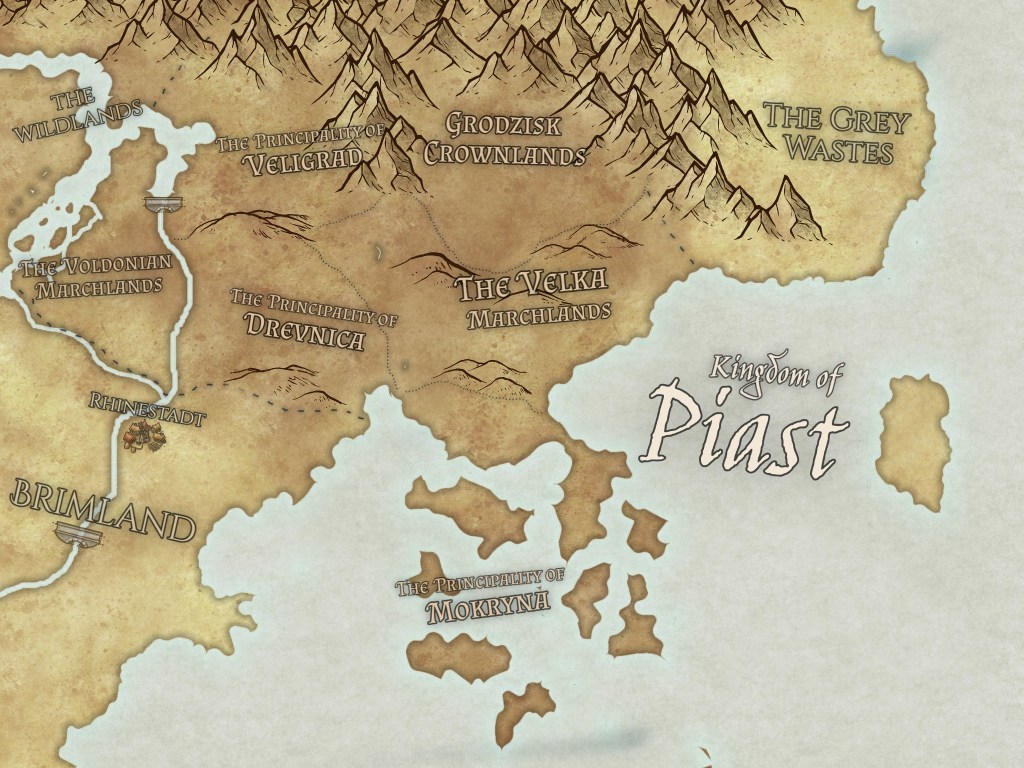
Piast is ruled from Grodzisk, where the King still holds the Crownlands. These lands are protected by mountain ranges, royal soldiers and rich mines silver. The King is wealthy, but isolated. Coin alone does not fill granaries, repair roads, or bring timber, horses, medicine, and skilled hands safely through hostile territory.
Beyond the Crownlands lie the Principalities, regions ruled by members of the royal family. Many of them are in open rebellion against the King and each other. The great battles have stopped for now, but assassinations, sabotage, and noble conspiracies continue behind closed doors.
Most common people barely care anymore. Trade has quietly resumed, farmers have returned to their fields, and villages are trying to survive. To them, the question is rarely “who is the rightful ruler?” but “will the road be safe, will taxes come twice, and will armed men knock on my door before winter?”
The Marchlands are where Piast’s control grows weak. These are borderlands of broken roads, old forts, warlords, raiders, and local powers who rule because no one else can. To the east lie the Grey Wastes, a cold and barren land of stone, wind, raiders, orcish tribes, exiles, and hard survival.
Magic and old powers
Magic in Piast is both respected and feared. Nobles often keep a sorcerer, sage, or learned advisor close for protection and guidance. On the isles of Mokryna, rumours speak of a hidden academy where sorcerers are trained through brutal trials. It is said to be as hard to find as it is to enter.
Among farmers and poorer villages, magic is far less welcome. A healer who knows too much, a child with strange dreams, or a stranger who speaks the wrong words may quickly become a target. Some are shunned. Some are driven away. Some are killed by people terrified of what they do not understand. Piastans rarely speak of gods the way other lands do. They speak of old powers, old habits, warnings, charms, and things better left respected. A piece of bread before a journey. A sip of drink at the threshold. A quiet fire beside the sickbed. A name not repeated in winter.
To outsiders, this may look like superstition, to a Piastan, it is common sense.
If your character is from Piast
A Piastan character is likely shaped by caution, hardship, local loyalty and superstition. They may trust family before law, village before kingdom, and experience before noble ideals.
They may be slow to trust, careful with promises, respectful of old customs and uncomfortable when others mock things they do not understand. But they do not need to be grim or cruel. A Piastan can be warm, funny, generous, protective, faithful, romantic, or deeply kind. Their kindness probably has roots, they know what it costs, and what it can be worth.
Character ideas
A Piastan character could be a folk healer mixing herbs, charms, and practical medicine; a caravan guard keeping trade alive between fractured regions, a spy or minor noble caught in the cold war between royal families; a deserter or exile shaped by warlords and old feuds; or a smuggler from Mokryna trying to stay ahead of both law and tide.
Your homeland can inspire your archetype, but it does not decide it. A healer does not have to be a Ritualist. A warrior does not have to be a Paladin. A mystic does not have to be an Arcanist.
Start with the character first, choose the archetype that supports the story.
How others may see Piastans
- Erindorians may see Piastans as harsh, suspicious, poorly mannered, superstitious, or dangerous.
- Brimlanders may see them as unstable borderfolk, useful guides, troublesome, or obstacles to expansion.
- Lorenia may see them as grim, provincial, uncultured, fascinating, or spiritually strange.
- People from the Wildlands may respect their endurance, but mock their attachment to villages, fields, crowns, and family grudges.
- Piastans, in turn, often see outsiders as people who speak too loudly, promise too easily, trust too quickly, and do not understand what the land remembers.
Playing a Piastan
If you play a character from Piast, think small before thinking grand.
- What village, road, mine, island, forest, shrine, or family shaped you?
- Who do you trust when law fails?
- What old custom do you still follow, even if you pretend not to believe in it?
- What did your home teach you to fear?
- What did it teach you to endure?
- What do you owe, and to whom?
Piast is not a land of clean heroes and obvious villains. It is a land of hard choices, old stories, practical people, dangerous roads, and debts that do not always die with the dead. To be from Piast is to know that the world is rarely fair, and to keep walking anyway.