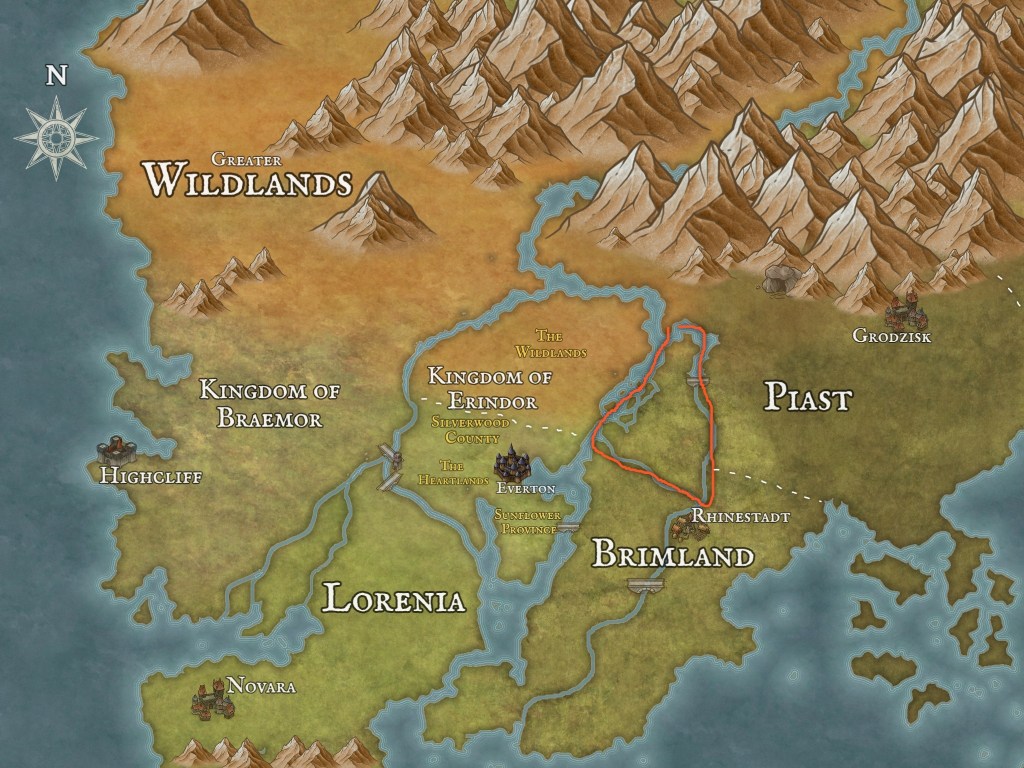
Our next chapter of the story takes place in the western borderlands of Piast, the part of the country closest to the Kingdom of Erindor and also contested by Brimland to the south.
One thing matters from the start: this is not a full overview of all Piast. Piast is a large, fractured land with many regions, peoples, customs, rulers and old beliefs. Our story focuses on one specific frontier region (outlined in red on the map).
A harsh and unstable stretch of land where borders are contested, local rulers come and go and few people still place much faith in crowns or nobility.
A Land Claimed by Many
Although this region is currently considered part of Piast, that truth is far from simple. Much of this land once belonged to Brimland and even now, more than a century after it fell into the hands of various Piastian warlords and self-proclaimed rulers, the matter remains unsettled. Brimland has tried more than once to take it back, usually by force, and usually without lasting success. Some say the rulers of Brimland have quietly accepted the loss, though they would never say so openly.
The Kingdom of Piast claims the territory as its own, but in practice the Kingdom has little real control here. Whatever authority exists on paper, its reach in this region is weak. Power lies instead with local warlords, petty kings, would-be queens, and armed strongmen who rule for as long as they can hold their ground.
Erindor, for its part, keeps its distance. The border is watched closely and it is often easier to leave Erindor than to return to it from this side. To most outsiders, Piast is unstable, dangerous, and deeply foreign. That reputation exists for a reason.
The Land Itself
This border region is not barren. It is rich in deep forests, fertile soil, wild rivers, game, herbs, and useful natural resources. In safer times it could be prosperous. Instead, that richness gives people even more reason to fight over it.
Villages and towns live under constant pressure from rulers who demand tribute, obedience, soldiers, supplies, or worship. Roads are unsafe, travel is slow, and even a short journey may involve armed men, scouts, raiders or worse. Beyond the roads and rough settlements lie the forests, and the people of Piast know very well that not everything living in those woods should be named lightly.
Power in This Region
This is not a land of stable courts or clear chains of command. Power here is local, personal, and often violent. A ruler may call himself king because he inherited a title, won a battle or simply gathered enough armed men to force others into obedience. A woman may crown herself queen because no one nearby is strong enough to deny her. Some rule through fear, some through superstition, some through loyalty, and most through a mixture of all three.
For ordinary people, that means life is rarely settled for long. A village may pay tribute to one lord this season and to another by the next. Alliances shift, borders mean little on the ground and authority is usually felt in the form of demands, threats, or armed presence rather than law.
The People of the Land
And yet, for all the claims of tyrants and border kingdoms, the land does not truly belong to them. Long before the current struggle between Piast and Brimland, long before today’s warlords and petty rulers, this region was already home to old families whose ties to the land run deeper than any recent conquest.
Many of these families function more like clans than neat feudal households. Their loyalties are shaped by blood, oath, memory, and shared survival. They are practical, resilient, suspicious of outsiders and deeply rooted in local custom spirituality.
They know the forests, the seasons, the animals, the herbs, the dead places and the things that are better left alone. Many do not bend the knee easily to any new ruler and if they submit at all, it is often out of necessity rather than belief.
Among these people, real authority often lies not with crowns but with figures such as “Babushkas”, “Don Modrons”, elders, and chieftains. These are the ones who remember the old ways, settle disputes, preserve stories, and know which customs still matter when times turn hard. Some clans are settled, others move from place to place and some live deep in the woods in hidden camps or guarded clearings known only to their own. Villagers often turn to them not for political leadership, but for protection, healing, blessings and advice.
Voldonia
Among the old families, clans, and many local villagers, this region is still often called Voldonia. According to local history and tradition, it was once a land of its own, long before Piast and Brimland began fighting over it.
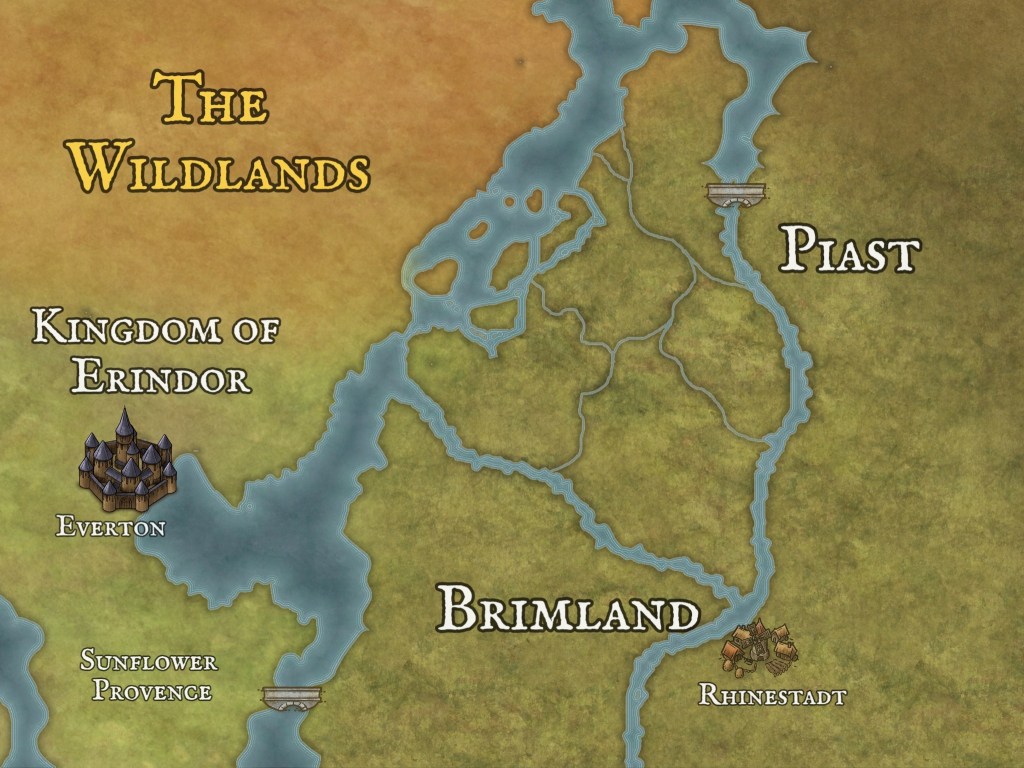
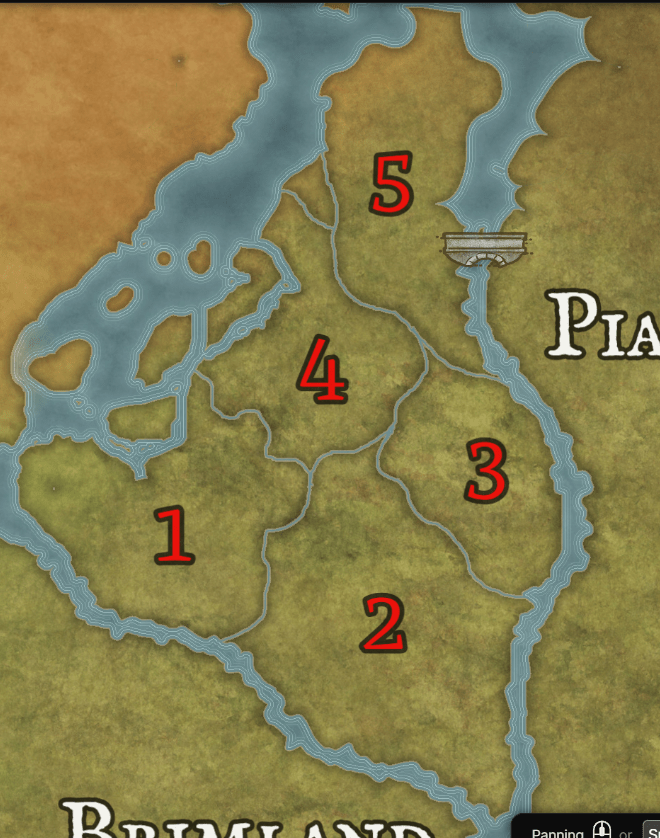
Voldonia is traditionally divided into five regions, due to the rivers. Each has its own settlements, local ties and ruling power, though those rulers are rarely stable for long. Some claim titles like king or queen, others simply rule through force, inheritance, or fear.
The region where this chapter takes place (1 on the map) is one of those five. It lies on the western side of Piast, close to the Kingdom of Erindor and under pressure from both outside claims and internal conflict. While Piast officially controls the area, local power is mostly in the hands of a cruel warlord and regional rulers.
Even so, many people who live here still see it as more than just disputed borderland. To them, it remains part of Voldonia, a land with its own history, identity, and people.
Faith, Superstition, and the Old Powers
Religion in Piast is not distant, polished, or organised in the way outsiders might expect. People do not usually speak of “gods” as noble, all-seeing beings who stand above the world. What they remember instead are old powers, names and presences tied to fear, grief, land, memory, survival, and the passing of seasons.
These powers are not worshipped in a clean or formal sense. They are acknowledged, honoured, feared, bargained with, and endured. A piece of bread before setting out on the road, clean water before tending a wound, a bowl left in the cold, blood mixed into the soil, a cup shared before song or celebration begins; these are not grand rituals, but they matter.
Names such as Varn the Wanderer, Mother Briana, Kiva Studena, Korun, and Bybamus are remembered across Piast, though not always in the same way. Some people speak of them often, others barely say their names at all. What matters is that superstition in Piast is not treated as foolishness. It is part of daily life. That also means belief can be used as a tool or a weapon. A ruler may demand reverence, a village may fear a curse more than a sword, and a clan may keep rites that outsiders do not understand.
What This Means for the Story
In this region, Piast is a fractured and dangerous borderland shaped by old customs, local loyalties, unstable rule, and deep-rooted spiritual traditions. It is not a stable kingdom with clear laws and orderly power. Authority changes from place to place, and daily life is shaped more by local rulers, clan ties, survival, superstition, and force than by any distant court.
This is the Piast you step into: a land that is harsh, suspicious of outsiders, politically unstable, and full of local conflict, old traditions, and hidden dangers. It is not empty wilderness, and it is not simple chaos. It is a place where history, fear, family, and belief still shape everyday life, and where the people who endure it have learned long ago that survival rarely comes from trusting those who wear crowns.
 Erindor